It's Not That Simple:
a treatise on fishing lessons
by Christopher Bryan and Katie Cook
How often we hear quoted the ancient
Chinese proverb: "Give a man a fish and feed him for a day.
Teach him to fish and feed him for a lifetime." Though well-intentioned
and-at first glance-logical, this adage does not really address
the complex issues facing hungry people.
One of the inherent dangers in the saying is that it implies
that people who don't have enough to eat are the sole cause of
their predicament. The logic suggests that they are in control
of their own fate, at fault because of their own deficiencies.
And our idea of self-sufficiency, of "learning to fish,"
assumes that, if they learn our uniform (most often translated
"Western") methods for growing food and supporting
themselves, they'll be all right.
Another danger in the proverb is that
it grossly oversimplifies the problem of food security. It encourages
us to ignore a significant number of major factors that cause
hunger. At work here are much more than ignorance or lack of
tools. Before we ask them to fish for themselves, we must ask:
Do the fisherfolk have access to a lake? Who owns the lake? Who
controls transportation to the lake? Is it polluted? If so, who
polluted it? Is it overfished by industrial interests? Who owns
the hooks and lines?
Our global economy has turned even the most basic natural resources
into commodities, making it sometimes impossible for people with
plenty of native knowledge and expertise to earn a decent living
or put food on their own table.
We as responsible people of faith should examine the roots of
these problems. Political instability and vast privatization
have led to circumstances in which knowing how to fish-so to
speak-doesn't necessarily grant self-sufficiency. The raw truth
is that people do not go hungry because they are lazy, or because
they don't know how to fish. They go hungry because they don't
have access to power.
The solution lies in helping peoplearound the globe, and
in our backyardsto empower themselves. Instead of urging
them to learn to fish, we should speak on their behalf regarding
injustices barring them from food resources. That means we, who
claim we care, should listen to people who work firsthand with
the hungry and malnourished-and we should listen to the hungry
and malnourished themselves. Once we have heard from them, we
can set about to fight the oppression that causes their hunger.
Of course, this is not a popular rallying cry. It is much easier
to fall back on a proverb that makes those of us in the developed
world feel a little less responsible, a little less guilty. It
is always easier to blame poverty on the poor.
In addition to our aversion of guilt, we also fear the idea of
transferring power to the powerless. We fear that we may have
to change our own lifestyles. We are also afraid because such
ideas tend to draw enmity from the people who hold most of the
power.
And we may not know for sure how to go about transferring that
power. We will probably disagree about the best ways to begin.
But it seems that, once we realize that some of those folks already
know how to fish better than we do, we've made a very important
step.
-Chris Bryan is a law student at the University of Chicago
and a former Seeds of Hope intern. Katie Cook is the Seeds of
Hope editor.
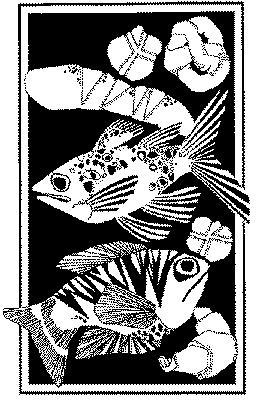
- Art by Melissa Storey and is used
with permission from Lake Shore Baptist Church, Waco, Texas.
- Originally from the October 1997
Sprouts (Volume 19 Number 10)
|