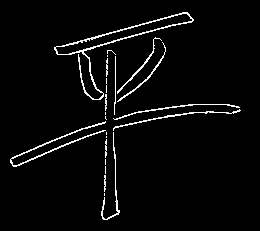
hei The meaning of this Japanese character is "even, calm, reconciled, settled down, normal"... It is the absence of valleys or peaks. It is also used to express: "equality, a peaceful feeling, well-balanced, recovery for the ill, ordinary people," and "justice."
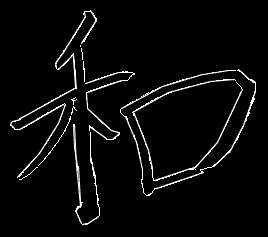
wa The meaning of this Japanese character is: (adjective) "soft, calm, harmonious, gentle, tender;" (verb) "relieve, ease, appease, moderate," etc. The idea of the specific character is a calmness due to harmony or balance. It is not "soft" or "tender" because of some external force; it represents a state of harmony or balance within its true nature. The harmony comes from a unity within diversity, not from conformity.This character is used to represent musical harmony--never melody alone.
"Real peace does not come from everything being the same, but different things coming together and existing in harmony. Even when there is no conflict, there still may be no peace," said Eiko Kanamaru, who gave us this description of the Japanese word for peace. "Originally," she explained, "Japan was an agricultural state. Whoever had the control of the crops was the leader. So rice itself was the basic ingredient to maintain peace among people."
--Eiko Kanamaru was born and grew up in Fukuoka, Japan, and was one of the first women ordained to the ministry by a Japanese Baptist Church. She wrote this while writing a dissertation about E. Y. Mullins for a Ph.D. in church history at Baylor University. She has since received her doctorate from Baylor University and returned to Japan. Her goals are to be a good Baptist and a good church historian.
This "Japanese Primer" first appeared in the November 1996 SPROUTS edition of SEEDS MAGAZINE.